2026-06-30 · ARCHIVE
NASA Astronauts Repair Canadarm2 Robotic Arm Outside the ISS | June 30, 2026
afarTV archive · original video retains full camera and production credits
Original video & credits ↗
International Space Station
Source feed provider: NASA ↗. NASA is the video source; no local camera host is credited.
See the ISS position, ground track, altitude and speed as it moves above Earth.
Explore the full ISS trackerLoading NOAA’s global geomagnetic observations…
Recorded footage, played here. Dates describe the archived event, not the current view.
afarTV archive · original video retains full camera and production credits
Original video & credits ↗afarTV archive · original video retains full camera and production credits
Original video & credits ↗Earth’s moving horizon is the visible result of an extraordinary history of engineering and cooperation. The International Space Station was assembled from separate components, building on earlier experience with orbital living and research. Its first modules and first resident crew marked important steps in a project that continued to grow. Behind each apparently effortless view of clouds and coastlines is that accumulated work: launches, construction, shared operations and the sustained effort to make a laboratory function above the atmosphere.
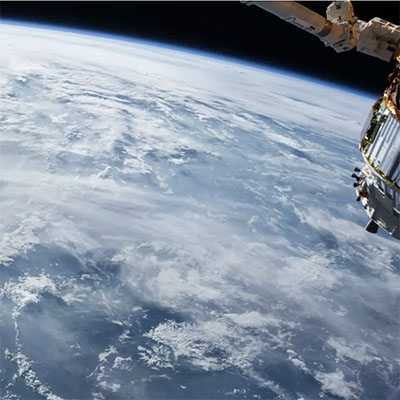
The International Space Station grew out of decades of experience with living and working in orbit. Earlier programs, including the Soviet Salyut and Mir stations and the American Skylab, explored how people could stay in space for longer periods. Plans for a permanently inhabited laboratory evolved as engineering ambitions met changing international relationships. The station that eventually emerged was built through cooperation among partners with different spacecraft, equipment and operational traditions.
NASA’s historical accounts describe how the project developed into the International Space Station during the 1990s. Its significance is therefore more than the size of the structure. It represents a sustained effort to connect laboratories, launch systems and crews across national programs. The images of Earth now shared from orbit belong to the history of that collaboration as well as to the history of cameras and communications technology.
The first station element, Zarya, launched on 20 November 1998. Unity followed in December, and the two modules were joined in orbit. Those initial components were the beginning of a much larger assembly process involving launches, robotic operations and spacewalks. The station was not delivered as one complete spacecraft; it grew through the addition and connection of separate structures over many years.
The first long-duration crew arrived on 2 November 2000. Further modules expanded the station’s capabilities, including Harmony in 2007 and the European Columbus and Japanese Kibo laboratories in 2008. This sequence helps explain the station’s distinctive appearance: its laboratories, connecting nodes, solar arrays and external equipment reflect a construction history. Every addition depended on the work of people in orbit and teams on the ground.
NASA’s assembly record identifies the individual elements that make the station function as a connected orbital laboratory. Modules provide working and living space, while the wider structure supplies power, thermal control and support for operations. The changing Earth view can make that engineering disappear from awareness, but it is what allows observations to be made and shared from a moving platform above the atmosphere.
The perspective is unlike that of a fixed terrestrial camera. The station is continually traveling around Earth, so coastlines, weather systems and the boundary between daylight and darkness pass through the frame. Looking back through its history places those images within a remarkable transition: from brief visits to orbit to an assembled outpost supporting long-duration human presence. The view is a reminder that Earth observation is both a scientific activity and a shared human experience, made possible by a structure whose own story has been built one component and one expedition at a time.
Historical background reviewed 18 November 2026.
Historical background reviewed 18 November 2026. Weather values are model data; camera images and archive clips do not establish current volcanic activity or local safety conditions. Cloud source checks are scheduled at 6 a.m. and 6 p.m. Vancouver time. The latest successful check appears in the notes above.