
A front row to the next launch.
Florida Space Coast · USA
Local time at the view
Camera host: Lyle. The people behind this view ↓
Camera host: Lyle · Titusville. Thank you for sharing the Indian River view. Published host credit ↗
Lyle · Our Space Coast host
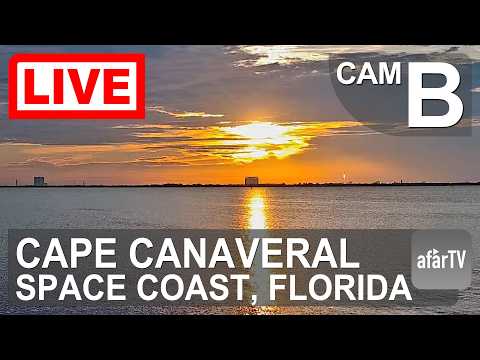
Thank you to Lyle for hosting afarTV’s Space Coast cameras overlooking the Indian River in Titusville. This local welcome helps share the view with our community around the world.
Credit: afarTV livestream description ↗
Moments that stay with you.
Recorded footage, with event dates where supplied.
No verified archive clip is selected yet. New matching afarTV highlights can appear through the configured updater.
Florida’s Space Coast: launchpads beside a living coastline
Florida’s Space Coast holds more than the memory of famous launches. It is a coastal landscape where spaceflight infrastructure, earlier settlement and protected habitats overlap. The development of Kennedy Space Center created the setting for Apollo’s departures while leaving extensive areas outside the operational footprint. Those lands became central to a different story of refuge and conservation. Looking toward the launch facilities therefore connects two histories at once: the ambition to leave Earth and the work of caring for a place on it.
A coast transformed by spaceflight
Cape Canaveral and the neighboring Kennedy Space Center occupy a coastal landscape that became central to American spaceflight during the twentieth century. The two names are often used together, but they refer to distinct, adjacent facilities. Early launches from the Cape and the development of NASA’s launch infrastructure on Merritt Island turned this part of Florida into a place associated worldwide with rockets, astronauts and journeys beyond Earth.
Kennedy Space Center’s expansion during the 1960s created the infrastructure needed for the Apollo program. The Vehicle Assembly Building, transport routes and launch complex formed a system designed to prepare and launch very large vehicles. Later programs adapted parts of that system for new purposes. The landscape therefore contains several generations of spaceflight history rather than one set of facilities that has remained unchanged since the beginning.
The departure point for Apollo 11
On 16 July 1969, Apollo 11 lifted off from Launch Complex 39A at Kennedy Space Center. The mission carried Neil Armstrong, Buzz Aldrin and Michael Collins toward the first crewed landing on the Moon. The launch became one of the most widely recognized moments in the history of space exploration, connecting a particular stretch of Florida’s coast with an event watched around the world.
A launchpad can appear to be a single destination for a rocket, but the mission depended on a far larger chain of preparation. Assembly, transport, testing, communication and coordinated work by many teams preceded the seconds of liftoff. Reading the coast through this history changes the meaning of its towers and large structures: they are the visible ends of processes extending across the center and far beyond it.
The refuge around the launch infrastructure
The development of the space center also produced an unusual conservation history. NASA acquired extensive lands on Merritt Island, but much of the area was not needed for buildings or launch operations. An agreement in 1963 established Merritt Island National Wildlife Refuge, and a later agreement in 1975 created Canaveral National Seashore. The result placed large areas of coastal habitat alongside one of the world’s best-known centers of space technology.
The refuge protects a varied landscape of wetlands, scrub, dunes and other habitats. Its history also includes the families who occupied and farmed parts of the land before the modern facilities were developed. These layers remain important when watching a present-day coastal view. The Space Coast is not solely a stage for launches: it is a place where earlier settlement, ambitious engineering and habitat protection overlap, with birds, weather and water continuing their rhythms between the much rarer moments when a rocket rises above the horizon.
Historical background reviewed 18 November 2026.
Go a little deeper.
Historical background reviewed 18 November 2026. Weather is model data for the stated reference point. Archived footage does not describe current conditions.