2026-11-16 · ARCHIVE
Nov 16, 2026: Rare Humpback Whale Sighting (Still in the Arctic!) Ilulissat, Greenland
afarTV archive · see original video for full credits
Video source & credits ↗
Ilulissat · Greenland
The stay behind the view: Jomsborg · Ilulissat Stay. Meet the people behind the view ↓
The livestream description links this oceanfront home as a place to experience the same view in person. Explore the property and accommodation information through Ilulissat Stay.
Discover the place behind the view ↗Credit: afarTV broadcast description ↗
Recorded footage, with event dates where supplied.
afarTV archive · see original video for full credits
Video source & credits ↗afarTV archive · see original video for full credits
Video source & credits ↗The ice near Ilulissat is constantly changing shape, but the place has a long and layered history. The glacier and fjord connect Greenland’s interior with the ocean, while archaeological sites reveal thousands of years of human life along their shores. Scientific observation and modern fishing communities add further chapters. The view is therefore both a moving natural scene and a meeting place of histories, where ice, water and people have shaped one another’s surroundings over time.
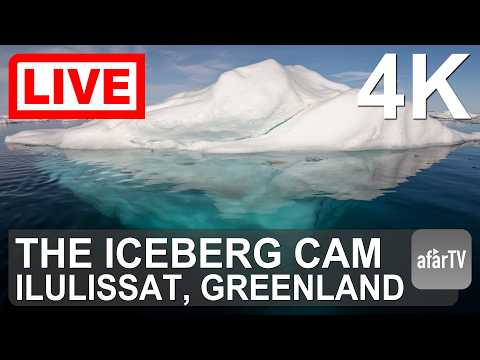
Ilulissat stands on Greenland’s west coast beside a landscape shaped by the movement of ice from the interior toward the ocean. The nearby icefjord, Kangia, receives ice from Sermeq Kujalleq, also widely known as Jakobshavn Isbræ. Icebergs passing through the fjord and into surrounding waters are therefore pieces of a much larger system, not isolated objects formed close to the town.
UNESCO recognized the Ilulissat Icefjord as a World Heritage Site in 2004. Its significance includes the combination of a fast-moving outlet glacier, the iceberg-filled fjord and a long history of scientific observation. The ice seen near Ilulissat connects processes operating deep within the Greenland Ice Sheet with the coastal environment. A single iceberg may change quickly, but the landscape records movement on a scale far greater than one day’s view.
The area’s human history reaches back thousands of years. Archaeological sites at Sermermiut and Qajaa preserve evidence of earlier communities whose lives were sustained by the productive waters near the icefjord. GEUS, the Geological Survey of Denmark and Greenland, describes the arrival of the earliest known inhabitants in this region about 4,400 years ago. The relationship between ice, marine life and people is therefore fundamental to the place’s history.
Later cultural changes did not erase that dependence on the coastal environment. Hunting and fishing linked communities with seasonal conditions, while the development of modern Ilulissat added new buildings, industries and connections. Understanding the town through this longer record helps avoid presenting the Arctic as an uninhabited wilderness. The icefjord has been a source of knowledge, food and livelihood across successive generations, and its surroundings preserve the traces of those relationships.
The ice near Ilulissat does not simply travel in a straight line from glacier to open ocean. Icebergs can ground, fracture, overturn and be redirected by water movement. Their shapes change as ice is lost, and their position reflects the interaction between the submerged part of the iceberg and its surroundings. GEUS’ work on the area explains why coastal ice can create such a varied and dynamic scene even over relatively short intervals.
That movement gives the camera view its distinctive character. A shape that dominates one day may disappear later, while differences in light and weather reveal features that were previously difficult to see. Long observations become especially valuable when connected with the scientific and cultural history of Kangia. They remind viewers that the landscape is not a frozen monument: it is an active meeting of glacier, ocean and community, carrying evidence of Greenland’s past while continuing to change in the present.
Historical background reviewed 18 November 2026.
Historical background reviewed 18 November 2026. Weather is model data for the stated reference point. Archived footage does not describe current conditions.